
Find the Capacity You Already Have Before You Buy More
Before buying a new line, measure how much time the machine that sets its pace is losing, and to what.
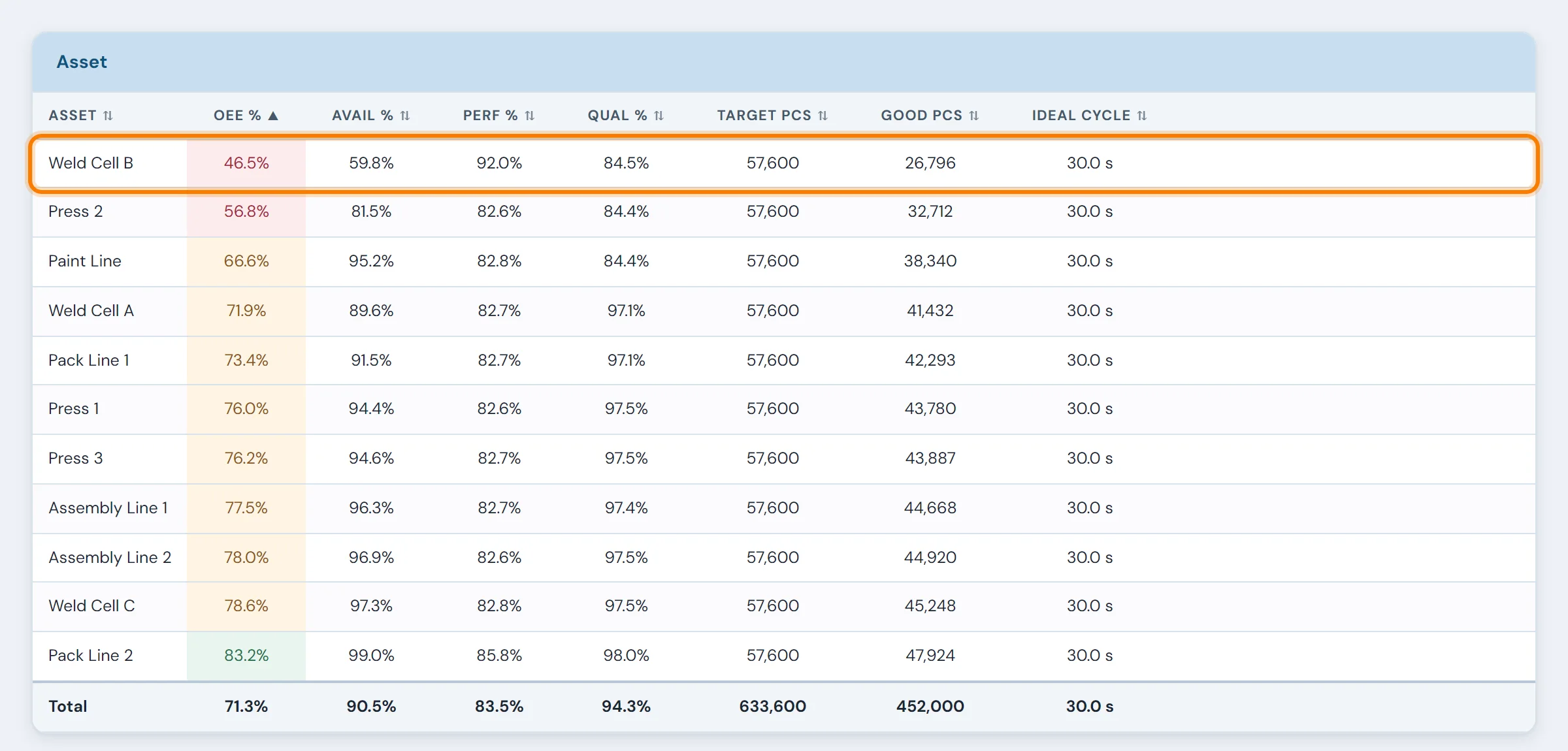
Why the OEE went up and the output didn't
A kaizen event lifts a machine's OEE by ten points, the chart goes up on the board, and weekly output stays where it was. The gain was real, but the machine wasn't the one limiting the line.
On a connected line, a machine that isn't the constraint has spare capacity by definition. Improving it makes it idle more often, blocked by the machine after it or starved by the one before. Meanwhile the constraint keeps losing time to the same stops, changeovers and slow cycles, and because nobody measured it separately, the loss is buried in the line average.
That's also how plants end up buying equipment they didn't need: the line can't keep up, the slowest-looking machine gets replaced, and the constraint moves one station down the line.
Four stations, one constraint
A four-station line running 80 planned hours a week. Nameplate speeds say the press is the slowest station. Effective rates, the ideal rate multiplied by actual OEE, say otherwise.
Improve pack OEE from 60% to 80%
Pack's effective rate rises from 48 to 64 an hour. Line output: unchanged at 39 an hour. The weld cell still sets the pace; pack just waits longer.
Improve weld cell OEE from 65% to 75%
The weld cell rises from 39 to 45 an hour. Line output: +15%, about 480 more parts a week from the same four stations and crew.
Then the constraint moves. Once the weld cell passes about 78% OEE (46.8 an hour), assembly becomes the constraint and the next improvement belongs there. So constraint management is a routine you keep running: measure, improve the constraint, see where it moved, and start again.
How to find the constraint
- Compare effective rates. Ideal rate × actual OEE for each station, from real data over several weeks. Nameplate speeds leave out every loss.
- Read the blocked and starved time. The stations feeding the constraint back up behind it, and the stations after it sit waiting for parts.
- Look for the pile. Work in progress building up in front of one station is the oldest sign there is.
- Check it by product and shift. The constraint can move with the product mix. A line that is weld-limited on one part may be assembly-limited on another.
Blocked and starved time is only useful if it's measured. 10in6 can pick up both states from connected machine and line signals, and Constraint Analysis separates stations causing lost flow from stations reacting to it, live and over time. For how those states are detected, see how production data gets from a PLC into an MES.
“Prior to 10in6 it was a challenge for us to quickly understand what our constraints were. The 10in6 reports have been very useful to point out those constraints and allow us to efficiently deploy our team to those areas.”
Where the constraint's time goes
Time lost at the constraint comes straight off the line's output, and the downtime cost calculator puts a price on an hour of it. Check these roughly in this order.
Starved and blocked time
The constraint waiting for parts, or unable to unload. Protect it with a small buffer in front and make sure what's after it can always take its output.
Breaks and shift changes
If the constraint stops whenever its operator does, cover it. Staggered breaks and a clean handover are often the cheapest capacity in the plant.
Changeovers
Setup and startup time at the constraint is capacity. Measure each changeover against its allowance and prepare everything before the machine stops. Glossary: setup, startup, changeover.
Breakdowns and minor stops
Rank the constraint's stops by lost time, and give its maintenance calls priority. Short, frequent jams add up. See reducing unplanned downtime.
Slow cycles
A 20-second cycle running at 21 or 22 seconds never shows up as downtime, but on the constraint it's a direct loss of output. Glossary: speed loss.
Scrap at or after it
A part scrapped after the constraint wasted constraint time. Catch defects before the constraint, and stop making them at it. See recurring defects.
Together these are the Six Big Losses, applied to the one machine where they matter most. OEE tracking on the constraint shows how big each one is.
Before you sign for new equipment, check these seven things
- Is it the constraint? Confirm it from effective rates and blocked and starved data before anyone quotes a nameplate speed.
- What does it make, against what you think it can make? Compare parts per scheduled hour with the rate you plan around. As a rough guide, if its honest OEE is well below 70%, recovering lost time is usually cheaper and faster than new capacity.
- Where does its downtime go? Minutes lost, each with a reason. If many stops have no reason, closing that gap comes first. Then check whether the losses cluster on particular products or shifts.
- How much of its loss is starved, blocked, breaks or changeovers? Those are fixed with scheduling and staffing, not steel.
- What is scrap costing on it? Find its scrap rate and the top cause. A part scrapped at the constraint is output the whole line has lost.
- Will new capacity just move the constraint? Check the effective rate of the next-slowest station.
- How will you measure the result? Take a baseline before, and agree what "worked" looks like.
“We use 10in6 when seeking budget for improvement projects. We can clearly show how a process is performing today, the impact of the issues we are trying to fix and the expected ROI. After the fact, we can easily measure to see if we achieved the goal. Our engineering team has built trust with the Controller because our requests are based on analyzing accurate data.”
What plants gained by working their biggest losses first
“Like most plants, we have many lines and many issues, but limited resources. Our engineers could walk around the plant and find things to fix all day. 10in6 helps us to focus our team on the highest impact issues, so we get the most value from our engineers.”
Set up around how your plant runs
Standardized platforms expect the plant to change to fit the software. Do-it-yourself platforms leave your team to build and maintain everything. With 10in6, we configure the system around your equipment, codes and reports, and your team runs it day to day.
Your equipment, codes and reports
OEE calculated from your own machine signals, using your expected rates and your rules for planned stops.
Your team runs it day to day
Operators, downtime and scrap codes, products and targets, shift schedules, checks, alerts, emailed reports and real-time boards are managed by your own people. Everyday changes need no support ticket and no invoice.
A project manager for the bigger things
New machines, new modules and custom reports go through a 10in6 project manager who already knows your deployment, so nothing starts from scratch. If you would rather we made everyday changes too, we can.
Still here years later
The system keeps being refined after go-live, and new capabilities are added without rebuilding it. Some of our customer relationships have run for 12 years, and 97% of customers say they would never go back.
“Our 10in6 Project Manager has been very responsive and the software is flexible enough to be configured to our specific needs.”
How the 10in6 delivery model works →
Questions about constraints and capacity
- What is constraint management in manufacturing?
- Constraint management means finding the one operation that limits how much the whole line can produce, and managing everything around it. A line can only produce as fast as its constraint, so an hour lost at the constraint is an hour lost for the whole line, while an hour saved anywhere else changes nothing. The method, from the Theory of Constraints, is to identify the constraint, get the most out of it, make everything else support it, add capacity only when it is maxed out, and then look for the next constraint.
- How do you increase production capacity without buying new equipment?
- Find the constraint and recover the time it loses: breakdowns, long changeovers, minor stops, slow cycles, scrap made at or after it, and time it sits starved or blocked. Then keep it running through breaks and shift changes, and move work off it where possible. Raising the constraint's OEE from 65% to 75% adds about 15% output from the same equipment and staff.
- How do you find the bottleneck on a production line?
- Don't rely on nameplate speeds. Look at actual effective rates (ideal rate × OEE) for each station, and at blocked and starved states: stations upstream of the constraint spend time blocked, stations downstream spend time starved, and the constraint itself is rarely either. Work in progress piling up in front of one station is the classic visible sign. In 10in6, blocked and starved can be captured from connected machine and line signals, so this doesn't depend on someone watching the line.
- What is the difference between a bottleneck and a constraint?
- People often use them interchangeably. Strictly, a bottleneck is any resource whose capacity is less than the demand placed on it, while the constraint is the single one that limits the output of the whole system at a given time. A line can have several slow machines, but only one is the constraint, and it can move when products, staffing or demand change.
- Why didn't our OEE improvement increase output?
- Usually because it happened on a machine that isn't the constraint. Improving a non-constraint makes that machine less busy, not the line more productive. The extra capacity only turns into output if it's at the constraint, or if it removes a starved or blocked condition that was stopping the constraint.
- When is it right to buy new equipment?
- When the constraint is already running at a high, honest OEE, is covered through breaks and changeovers, isn't losing time to starved, blocked or scrap, and demand still exceeds what it can produce. At that point new capacity at the constraint pays off. Buying before then often just moves the constraint somewhere else, or adds a machine that sits starved.
Check the line before you sign for the machine.
Tell us about the line that can't keep up and the decision you're facing. We'll show you how to find its real constraint and what it's losing, before anyone signs for new equipment.
Free 30–60 minute call with one of our engineers.